Several months ago, I was at a point where I felt keenly my flaws. While in church on a particular Sunday during that time, I spoke in front of the congregation, and I said that the older I get, the more I realize that I need Jesus Christ.
In my notes among my list of possible concepts for parables for this website, I had an item about not being able to cleanse myself, that I must be cleansed by Him. However, as I gave that some thought, my mind went back to the Parable of the Silver Pitcher and an element of the story that I glossed over the last time I gave some interpretation of that parable.
The gospel of Jesus Christ contains what appear on the surface to be dichotomies or contradictions. But when you look more closely with a balanced view, seeming incongruencies become details that help us understand our Heavenly Father more deeply.
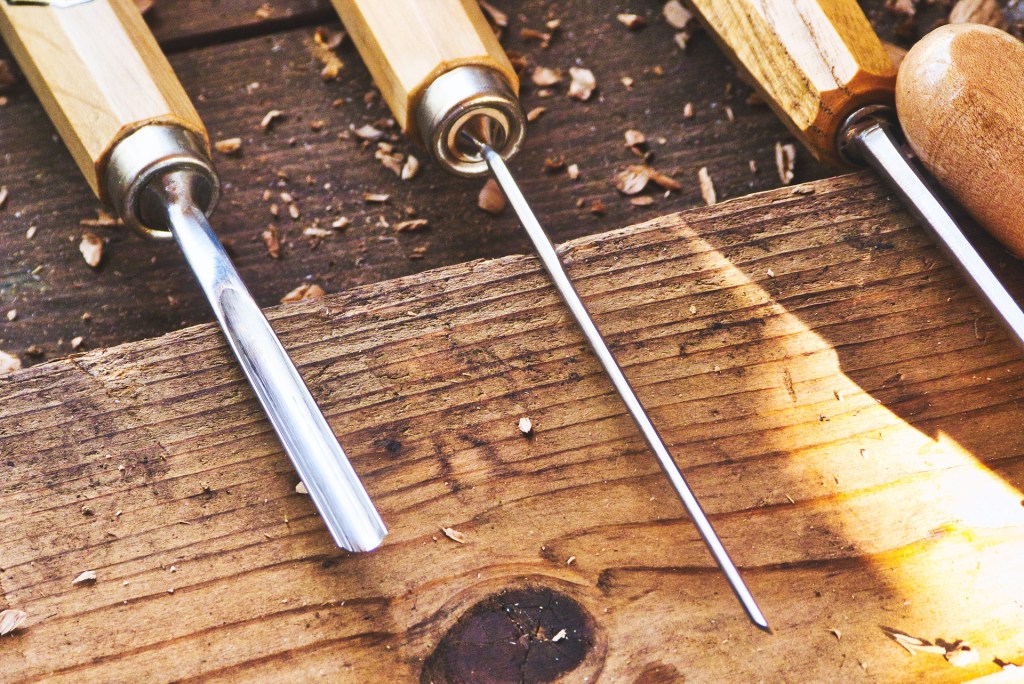
The Parable of the Woodcarver touches on a couple of these dichotomies that represent God’s workings with us. The woodcarver himself, of course, is our Father, and we are the wood in His hands that become fine carvings.
First is the idea that as the One doing the shaping, He has complete control, but at the same time, the carving takes on a life of its own. How is that possible?
Camille N. Johnson gave a talk in October 2021 general conference of The Church of Jesus Christ of Latter-day Saints called “Invite Christ to Author Your Story.” In this talk, she said:
“[Christ] is mercifully willing to use me, a scrawny pencil, as an instrument in His hands, if I have the faith to let Him, if I will let Him author my story. . . . Letting God prevail, letting Him be the author and finisher of our stories, does require us to keep His commandments and the covenants we have made. It is our commandment and covenant keeping that will open the line of communication for us to receive revelation through the Holy Ghost.”
Sister Johnson is talking about surrendering to God and letting his will prevail in her life and in mine. To surrender is to stop fighting and accept the opponent as the victor. Except, God is not my opponent. At least, He doesn’t want to be. He doesn’t want to fight with me. He wants to join with me and have me join with Him in His glorious work. I’m the only one who is fighting. Like the old farmer in the Parable of the Meddling Neighbor, I foolishly put up resistance to everything that is meant for my good.
It’s no secret that millions or even billions of people are searching for meaning, fulfillment, happiness, success, or whatever they may think the measurement is of purpose in life—while the key to those things remains a secret for most. Ironically, queries to Google for these things return no fewer than 3 billion results (but hey, delivered in less than a second!). So we have no shortage of places to look.
Many, searching for something they can’t quite define, wander from one risky behavior to another, and some realize in time that those behaviors don’t bring them what they’re after. Others drift from relationship to relationship. Still others pursue modern definitions of success or happiness and discover it’s a false promise.
The Parable of the Soda Fountain depicts these pursuits as different flavored drinks at a carnival. In the story, Jenna represents any of us when we opt for the more colorful and sweet-tasting offerings in life. But at what cost? To me, it’s a story of a universal search for satisfaction. None of these other “drinks” truly quenches a person’s thirst as much as pure water.
Although each of the four Gospels relates events from the night of the Passover and the Crucifixion the next day, they are reverently scant on details about Jesus’s suffering. One of the things we do know is that in the Garden of Gethsemane, “being in an agony he prayed more earnestly: and his sweat was as it were great drops of blood falling down to the ground” (Luke 22:44). Over a century earlier, an angel prophesied to the prophet-king Benjamin: “And lo, he shall suffer temptations, and pain of body, hunger, thirst, and fatigue, even more than man can suffer, except it be unto death; for behold, blood cometh from every pore, so great shall be his anguish for the wickedness and the abominations of his people” (Mosiah 3:7).
The saying goes that a sparrow shall not fall to the ground without God’s notice (a mixture of similar passages in Matthew and Luke). How much more then was every drop of His innocent blood He shed for us honored of His Father, in part because those drops fell for us, the rest of God’s children. Gethsemane being the garden of the oil press, Jesus there took upon Himself the incomprehensible weight of our sins, flaws, and other struggles. I would suggest that it was not some massive conglomeration of the horrors and heartaches of mortality that fell upon Him, but rather the cumulative weight of individual sins and pains, large and small, innumerable to us.



 The Weekly Parable