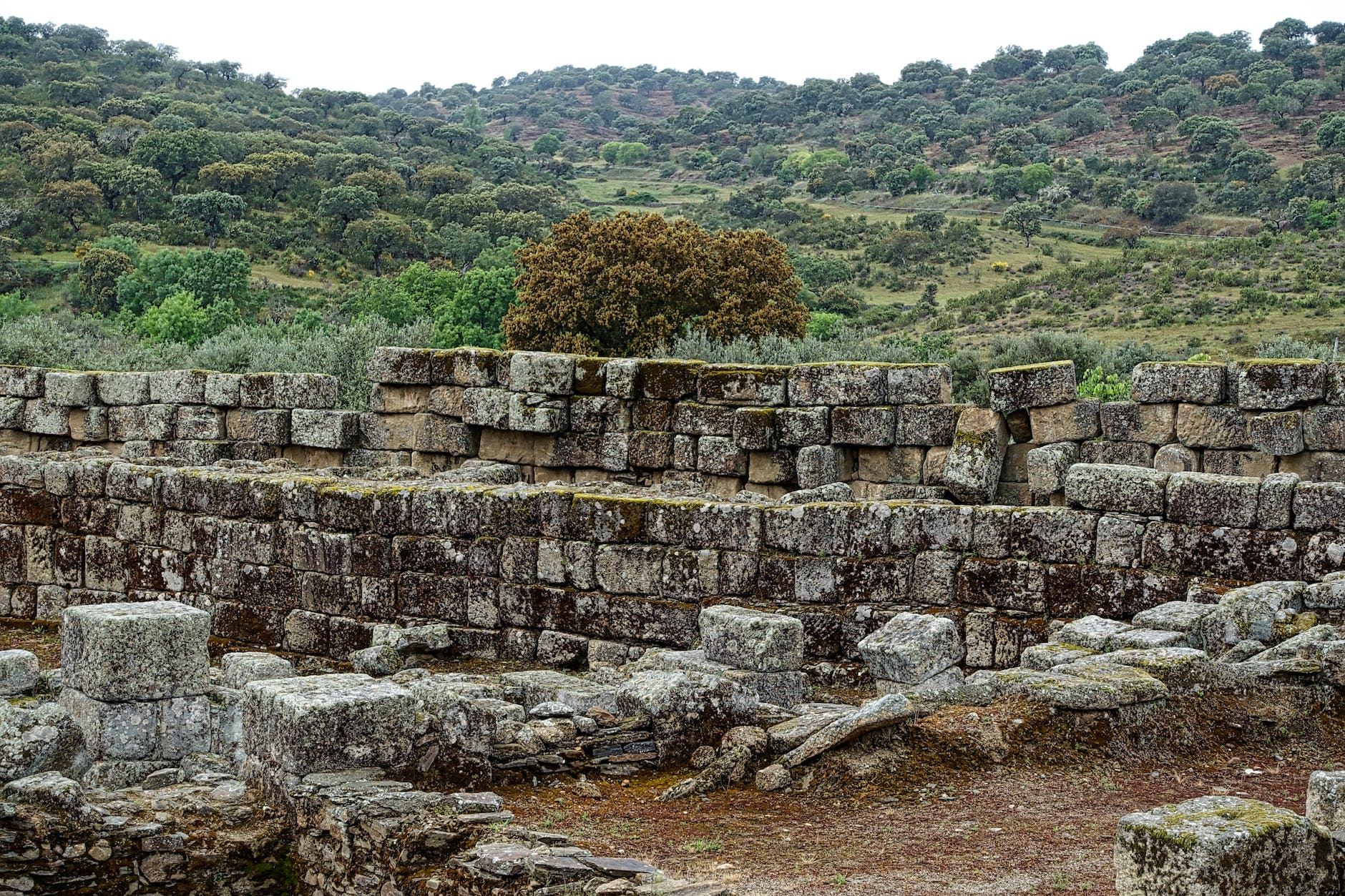
Helena couldn’t contain her excitement at the opportunity that had just been granted her, and she let out a whoop right there in her office. The government of a nation halfway across the world had selected her archaeological team to excavate what they thought were some ancient ruins outside one of their cities. A farmer had been preparing a field for planting after flooding earlier in the year had washed some of the soil away. He had plowed into a large stone. On closer inspection, he found it to be a hewn block.
Helena’s team began their dig with high hopes. They removed earth around the original stone and found others laid together in a square. They dug holes nearby and found it was part of a square made up of more stones, with a gap on one side. Further efforts unearthed more stones that provided an outline for what appeared to be a collection of small buildings’ foundations.
However, Helena and her team uncovered only a handful of foundations. They suggested very small buildings clustered close together. The questions still significantly outnumbered the answers.
Helena scratched her head. Why would such a small number of buildings be constructed in such proximity?
As the dig continued, the team found the remains of a wall that enclosed these small foundations. Like the buildings, it likely stood higher anciently. The wall formed a perfect rectangle with a single opening midway along one long side.
After digging some more, they found that that the buildings and the surrounding wall sat on a shared pavement of large stone blocks. This pavement ended at the outside edge of the enclosing wall.
A narrow trough ran from one corner of each foundation to the wall, connecting to a fist-sized opening at the wall’s base. “These look like rain gutters!” Helena exclaimed. “There is pretty frequent rain around here.”
The team stepped back to look over what they had uncovered. This is a fantastic find! Helena thought.
One of her team members took off his hat. “Well, there’s not much here. We know a few people must have lived here and they didn’t like rain puddling around their homes.”
“I don’t know,” replied another. “I don’t think this is all there is to it. Our understanding is still so … shallow.”
Helena smiled. “Then we dig.”
Carefully, the team set about removing earth around the edge of the pavement. To their delight, they found carvings on the sides that centuries ago would have been intricate but had since worn down. They dug further and discovered another row of hewn blocks beneath the first. “Is this actually one larger building?” someone wondered aloud, echoing Helena’s thoughts.
It was. In fact, the blocks in front of the opening in the wall extended outward in a square. Further digging revealed steps descending to one side from this landing. The team members looked at each other with wide eyes. Stairs meant more to discover!
An opening took shape next to the steps. Upon clearing it of dirt, the archaeologists looked through it into darkness. A window to a chamber!
Soon, Helena knew they needed heavy machinery to move the tons of earth around this structure as the steps continued to descend. An excavator was brought in, and Helena gave the operator explicit instructions on avoiding damage to the building.
Following weeks of digging, a sizable, tapering building like a short ziggurat stood revealed within an expansive pit. Helena and her team found the entrance where the steps ended and explored the rooms within. They found stone tables, vessels, and other artifacts suggesting that some sort of religious activity must have taken place here. “The buildings on top must have had some use during public ceremonies,” Helena hypothesized. “They had the gutters to keep it from flooding up there and the wall to keep their leaders from falling.”
That night, the archaeologists sat around a fire, discussing their finds. “So that’s it,” said one. “Looks like we uncovered everything. It’s over, and we move on.” Others slowly nodded. It seemed that the team had exhausted this site and there was no more to learn.
A part of Helena refused to believe that this site had no more to reveal to them. Was there more? Could they go deeper?
The next morning, feeling like she had missed something, Helena went back into the ground floor of the ziggurat. She looked around each room. Something about the dimensions seemed off. She went back to the camp for some graph paper and measuring tape. Curious, her team followed her and helped measure out the rooms.
They found that one inner room wasn’t as long as it should be.
“There’s something behind this wall,” Helena said. “But how to get to it?”
One member of the team discovered a handhold in a crevice on the wall, something they had mistaken earlier as a blemish in the stone slab’s edge. He firmly pulled on it, and the slab swung open. Just inside, another set of steps extended downward to their right.
“Go deeper,” Helena said, switching on her flashlight. She began her descent.
Grinning like kids at Christmas, eager for more answers, the rest of the team followed.
Photo by Pixabay on Pexels.com
On commenting: Please share your thoughts! You can leave an email address, but it’s not required. Leaving an email address may prompt you to sign in with a social media or WordPress account.
 The Weekly Parable